
Contested Will vs. Shakespeare Was a Woman and Other Heresies
Did Shakespeare write his plays? Is it a valid question? Should we ask it? Entertain it? Discuss it? Dismiss it?
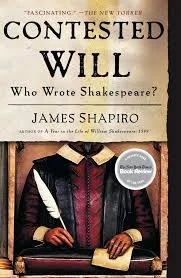
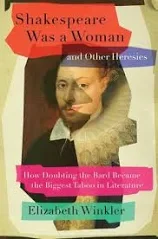
I recently watched a documentary that asked this question and set out to prove Shakespeare was a fraud. I found myself laughing out loud at scholars mocking and refuting each other. I remember watching Anonymous in a college English class (and finding it utterly ridiculous), but I’d never considered this question at all. I was fascinated to find not just one, but several, documentaries available on the topic. And then a friend started telling me about this book she’d just read, by Jodi Picoult of all people, imagining Shakespeare’s plays were written by the poet Emilia Bassano. Curious, I devoured all of By Any Other Name in a single weekend. And then I wanted to know more.
Do I believe Shakespeare wrote his plays? Yes. Am I intrigued that others don’t? Also yes. Deciding I wanted to learn more about this un/popular scholarly debate, I picked up two books, Contested Will: Who Wrote Shakespeare? by James Shapiro and Shakespeare Was a Woman and Other Heresies by Elizabeth Winkler.
In his prologue, Shapiro states that his interest is less in what people think and more in why they think it. Why, he questions, two centuries after the death of Shakespeare, did so many people start questioning whether or not he actually wrote the plays? I was intrigued by the premise of simply exploring why the question exists rather than trying to actually answer the question.
Winkler, on the other hand, opens with questioning who has the authority to ask questions about Shakespeare. She concludes in the first paragraph that it is “a small but highly prestigious subset of English literature professors” who are “priests” of “the highest god—the god who gives English literature as a discipline its very raison d’etre” (1). She explains that in Shakespearean scholarship circles, the authorship question simply does not and cannot exist.
Okay. I admit that as she began, I found myself rolling my eyes. Right off, she comes across defensive and petty, immediately disparaging those who refuse to entertain the question. She continues:
“If you raise it casually in a social setting,” she warns, “someone might chastise you as though you’ve uttered a deeply offensive profanity. Someone else might get up and leave the room. Tears may be shed. A whip may be produced. You will be punished, which is to say, educated. Because it is obscene to suggest that the god of English literature might be a false god. It is heresy.” (1)
Here’s where I began to laugh—and frankly, commend her for such a smart and immediate tie-in to the title of her book. She began to pose questions that many “anti-Stratfordians” (as I learned they’re called) ask: What happened to his library and works? Why didn’t he care about educating his children? Where did he get his knowledge from? How did he come to write feminist drama?
While Shapiro’s aim is to explore the question “Why do people question this?”, Winkler asks “Why do people get so upset when people ask this question?”
Winkler explains that her fascination with this phenomenon was especially heightened when she wrote an article for The Atlantic hypothesizing that Shakespeare was, in fact, a woman (specifically Emilia Bassano) and began to receive tons of criticism and backlash—and at the heart of it was none other than James Shapiro. Winkler quotes his responses to her article extensively. The one I found particularly intriguing was: “I once found conspiracy theories like this mildly amusing. I no longer do. I hope Winkler abandons her authorship fantasies” (17).
I was stunned on two accounts: one that a Columbian professor would write such a comment publicly, and two that Winkler called him out in print.
Shapiro acknowledges and discusses the opposing views with academic research, using a professional tone and smart language, and when he does insert himself to the conversation, it is only to express his frustration at what’s at the heart of this conversation for him: a dismissal of Shakespeare’s imagination. Rather than attacking opposing scholars individually, he merely attacks their arguments, calling out historical mistakes, common misunderstandings, or errors in logic:
“…if you were going to put someone else’s name on a play, nothing could be more foolish than to use a real person’s name, especially that of someone highly visible, such as an actor who could easily be hauled in and questioned.” (227)
“What they overlook is that just three years after his death a set of Shakespeare’s selected plays…was already for sale in London.” (240)
“Are we to suppose that as reputable a historian as Camden must have been in on the conspiracy as well—and willing to lie in print?” (237)
“Those who question Shakespeare’s authorship of the plays never get around to explaining how this alleged conspiracy worked.” (225)
Winkler, however, takes an entirely different approach, calling out “Stratfordians” by name left and right, including, but not limited to Jonathan Bate, Stanley Wells, Gary Taylor, and Stephen Greenblatt. She asserts that Shapiro’s reason for writing Contested Will in the first place is to put an end to the authorship question and proceeds to break down some of his arguments verbatim:
Secure in the conviction that no one before the 1840s doubted Shakespeare, he wondered: “Why, after two centuries, did so many people start questioning whether Shakespeare wrote the plays?” (One might similarly ask: Why, after so many centuries, did people start questioning whether the sun revolved around the earth?) … Shapiro argues from two premises. The first is his own belief: “I happen to believe that William Shakespeare wrote the plays and poems attributed to him.” The second is that those who don’t believe are in some way disturbed…” (19-20)
Winkler has a point. Shapiro attributes the beginning of the anti-Stratfordian movement largely to the work of Delia Bacon, who spent her life arguing that Francis Bacon was the true author of the plays. He argues that if she had “limited her argument to these points instead of conjoining it to an argument about how Shakespeare couldn’t have written them, there is little doubt that, instead of being dismissed as a crank and a madwoman, she would be hailed today as the precursor of the ‘New Historicists…” (97). To be fair, Shapiro goes on to explain that Bacon’s contemporaries dismissed her in this way, citing Richard Grant White, who, invited to write an introduction to Bacon’s essay by her editors, refused, insisting “she must be insane; not a maniac, but what boys call ‘looney.’” Even after her death, Shapiro notes, White choose to “vilify [rather] than refute her work, unfairly calling it a product of a disturbed mind, ‘a mental aberration which soon after consigned her to the asylum in which she died’” (105).
John Thomas Looney wrote the book “Shakespeare” Identified, which is considered to be the founding text for the belief that the Earl of Oxford wrote Shakespeare’s plays. Explaining that Looney believed it impossible that Shakespeare could have simply retired to the country and left the stage without a trace, Shapiro concedes that Looney presents a logic argument—but only if one holds to the belief that writers don’t write for money and that fiction is always autobiographical. Shapiro also calls out that Looney’s family name is “the subject of much unwarranted abuse” and even notes that the correct pronunciation rhymes with “bony,” which seems worth noting to his credit (169).
Although there were times I found myself a bit exhausted by Winkler’s defensiveness and frankly shocked at the candidness and boldness with which she named scholars and described encounters, I also found the look inside the feuding scholars quite entertaining. The two approaches are vastly different: Shapiro’s is incredibly academic and written as such; Winkler’s is far more journalistic in style. The latter is simply more engaging, as her voice and personality come through her writing—though, of course, that’s simply a characteristic of genre.
While both address similar points—the origins of the theories, the question of the role of autobiography, commonly posed candidates, and so on—they do so in very different ways. Shapiro clearly defines the history of the question and where it rose from, then dedicates a large space to renowned authors and thinkers who have lent belief and support to the Shakespeare authorship theory, including Nathaniel Hawthorne, Mark Twain, Henry James, Helen Keller, and Sigmund Freud, before finally explaining why Shakespeare must have been Shakespeare. Winkler chooses a more zoomed out approach, examining why scholars are afraid of this question, presenting common arguments for another candidate, and raising a number of questions that only lead to more questions.
Both set out with an answer already in mind. Though both accuse the other of close-mindedness, I found neither book to be entirely open or to approach the question without a ready-loaded conclusion. Rather than asking questions to lead to an answer, both only posed the questions that would lead to the already determined answer. Shapiro maintained a more professional, academic tone and refrained from personal attacks, but Winkler’s “no fucks, here’s what they said” reporting was nothing less than entertaining.
At the heart of each is a common theme of autobiography and its role in fiction writing. While Winkler questions how a man like William Shakespeare of Stratford could have come by the education, courtly and legal knowledge, and geographical awareness he did, Shapiro insists that autobiographical readings detract from what he loves most about Shakespeare: his imagination. In his section on Mark Twain, Shapiro summarizes that what led Twain to believing someone other than Shakespeare wrote the plays is his “conviction that great fiction, including his own, was necessarily autobiographical” (112). This point seems at the heart of either argument: does good fiction require autobiography?
Overall, while I find Shapiro’s arguments more grounded and rooted in credible sources, I thoroughly enjoyed Winkler’s writing, voice, and style. I also learned more from her book about the authorship question as a whole than I did from Shapiro’s and found it far more entertaining to read. I felt more as if I were following a woman all over England in her quest to solve a mystery rather than listening to a literature professor in a classroom (though I do love listening to a literature professor in a classroom). Neither can be called objective or entirely respectful to their opposition, nor can either be labeled an open-minded exploration of the authorship question. I found much to admire in both, and yet, some lacking in both as well. Both put forth arguments that have obvious rebuttals they choose not to explore, and neither truly considers that the opposition could be correct after all.
Winkler hardly convinced me of her heresies, but she did stir a deeper interest in learning more about where these conversations come from and why (and in watching scholars argue back and forth—there are few things I love more than a scholarly feud!).