
Holbein’s The Ambassadors and Anne Boleyn
My first encounter with The Ambassadors was atop my British Literature I course sophomore year of undergrad. As my favorite professor, Dr. Hall, outlined our course objectives and readings for the semester, I stared at the small black and white image, Jean de Dinteville and Georges de Selve peering back at me with mysterious eyes. I was captivated by the image, though I didn’t yet understand it.
Later that semester, Dr. Hall pulled the painting up on the projector screen, hopping in and out of the light as she pointed out the symbols, explained what they meant and why they were important. The skull danced across her as she stood in the way of the light, slanted across her, her face and voice enthusiastic as she taught us words like anamorphosis and memento mori. They held secrets in their lips, in the skull pin on de Dinteville’s cap. They knew things. I could tell.
When I told her I was considering studying abroad in London the next semester, she told me I had to. When I stood in the National Portrait Gallery a few months later, face to face with the real Ambassadors, I wanted nothing more than to use my international flip phone to call her office back home, tell her where I was standing, who I was looking at. How it felt.
My best friend, Mary Beth, laughed as I moved to the side, stood at an angle. “The hell are you doing?” she asked. “Come over here,” I told her. I showed her how the skull, slanted down into the floor, worked like an optical illusion. How you could only see it in its fullness by not looking at it straight on.
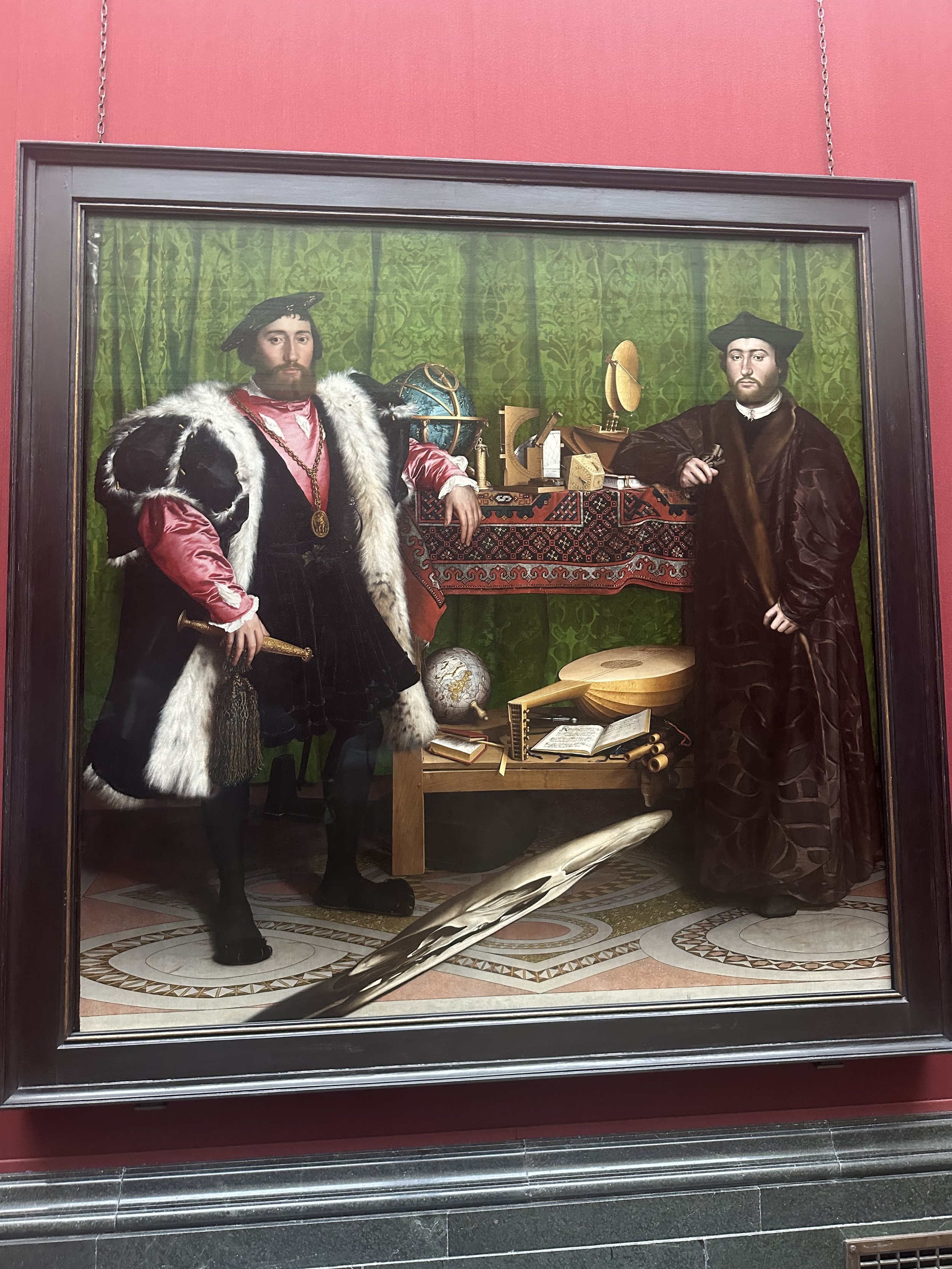
The Ambassadors hanging in the National Portrait Gallery, 2023
I saw it for the second time when my partner took me to London for my birthday three years ago. The weight of it, the way my 19-year-old self echoed in the green curtain, in de Dinteville’s gaze, the Westminster Abbey floor. When I looked at it, I thought of Anne Boleyn. I knew Holbein was the King’s painter. I knew he’d documented Henry VIII’s reign in brushstrokes: the whole thing somehow through his eyes. A secret you almost knew, but didn’t quite.
The court of Henry VIII, secrets, Westminster Abbey, items in disarray and chaos on a shelf. The globe turned upside down, and Europe too. A crucifix hidden, but peeping out—still there. An anamorphic skull: a picture of death hiding in plain sight. Because you can only see it in its fullest when you don’t view it straight on. Of course those things made me think of Anne Boleyn. All of that described Anne Boleyn.
What I’d forgotten is that when Dr. Hall analyzed the painting, her whole point was that this one portrait captured not just England, but all of Europe, during the year in which it was painted, 1533.
The Symbolism Behind The Ambassadors
On Wilt Sunday, 1533, Anne was crowned Queen of England. This was a problem, of course, because England already had a Queen: Katherine of Aragon. The King had married his brother’s widow with papal dispensation. This wasn’t abnormal. Lots of monarchs during this time married their relatives’ widows[i], and requesting and being granted a papal dispensation to do so was common practice. Not only was this encouraged in the Book of Deuteronomy[ii], it made sense politically. When a spouse dies, an alliance can fall apart. Katherine (Spain) marries Arthur (England), but Arthur dies. To maintain the Spanish alliance, the Tudors need a Spanish princess.
The Pope grants permission for Henry VIII to marry Katherine of Aragon, whether or not her marriage to his brother was consummated. When Henry decides he wanted a new wife, he requested Pope Clement VII grant an annulment. But here’s the problem with that: if one Pope declares his predecessor made an unbiblical ruling (a mistake, even) then the authority of the Pope is now open to question and all of those other monarchs also have unlawful marriages. It’s in the best interest of both the church and literally every kingdom politically to rule against Henry VIII. It’s literally Henry vs the world. If his marriage is invalid, so are theirs, and belief in the Pope’s divine guidance risks becoming unstable. This is just asking for war and chaos.
What I learned as a 19-year-old was that all of this was inside that one painting. Anne finally winning was turning all of Europe upside down. Anne’s marriage to Henry didn't just disrupt England; it disrupted a continent. She turned the heavens upside down.
That’s what Holbein was saying.
I’d forgotten all of that, but my subconscious hadn’t. The 19-year-old English major in me, hungry for literature and stories, longing for a life in London, pouring over books—she knew Anne Boleyn was all over that painting. But 33-year-old senior marketing content writer me, a former college lecturer and graduate student trying desperately to keep up with a corporate pace of life, who hadn’t read anything but contemporary fiction in years, who barely had time to read or write anymore because her brain was full of spreadsheets and bottlenecks and circle backs and low bandwidth... she’d forgotten why it made her think of Anne. Only that it did.
We saw As You Like It at the Globe. We saw Six the Musical on West End. We stood at the site of the scaffold at the Tower of London. I went the gardens behind the flats where Mary Beth and I once lived, and I smiled on the District line remembering a boy I could’ve loved once who lived at Earl’s Court.
And I felt like I’d been hiding inside my own painting for years. The only person who could help me climb out of it?
Anne.
Because when I’m studying Anne’s upside Europe, when I’m crouching inside her sixteenth century, then I’m not in my 21st trying not to read the news about what’s upside down in my country. Because I can’t read any more stories about this Republican or this Democrat. I’d rather read about this Catholic or that Protestant. I’d rather get lost in Anne’s tragedy than America’s. I’d rather think about the people who lost their lives at the hands of Henry VIII[iii] than read about the ones who lost their lives in Minnesota. I’d rather wonder why Mary Boleyn disappears than mourn for the ones disappearing here.
The past is the only thing lately that’s keeping me grounded.
A Second Analysis
Seeing the portrait in real life a second time, not as a 19-year-old, but as a thirty-three-year old, felt different. Heavier. More surreal. More incredible. Centuries ago, this man sat down and painted a whole story into the backdrop of a portrait through symbols alone, mere objects.
Tracy Borman discusses her book The Ambassadors, part of a series by the National Portrait Gallery, on Natalie Grueninger’s Talking Tudors podcast. Thrilled to discover Borman had written an entire (albeit short) book on the painting, I immediately ordered a copy from Blackwell’s.
In The Ambassadors, Borman writes, “Jean de Dinteville instructed Holbein to capture this extraordinary moment through a portrait of himself and his fellow ambassador, both of whom were caught in the eye of the gathering storm.”
Jean de Dinteville arrived in England in January of 1533, an ambassador for Francis I. Georges de Selve, a cleric, visited him in May that year. One fascination I have with this painting is that it’s unclear how they know each other or what their relationship is. They’re facing one another, as a couple would do in a portrait. Both had connections with the French court, but no other link between them has ever been confirmed. Who were they to each other, and why did they choose to be painted together? Tracey Borman also pointed out that it’s very rare for an artist to paint full length portraits of their subjects except usually in the case of marriage portraits or royal commissions.[iv]
Incorporating objects into portraits was common practice during this time; usually, it was meant to suggest the wealth and status of the sitter.[v] Many objects rest on a shelf between the two men—many objects that would’ve only been owned by a wealthier class. Perhaps, then, this could’ve served as a true and surface-level explanation to anyone who raised an eyebrow at the symbolism present.
But I believe Holbein to have been a careful man—after all, as XX points out, he’s one of the only characters to last through all six queens and keep his head. While including astronomical instruments, for example, is common (many of the same are featured in his portrait of Nicholas Kratzer), it seems unlikely that he painted all of these objects to convey something as simple as material wealth. If that were the purpose, why go to the trouble to include some of the exquisite detail present? Why make the altercations present, as in the upside globe and Lutheran hymnal? What was Holbein trying to convey, and to whom? Who commissioned this painting, and why?
Answering these questions (by which I mean, speculating as to the answers) requires a closer examination of the shelves and their items.
An inventory:
The globe is turned on its side and upside down. Centerstage is Europe. The focus seems to be on France, specifically Dinteville’s home in Polisy. Borman points out that this focus later becomes an important clue in identifying the two men.[vi]
The lute has a broken string, a symbol of discord, while the case of flutes is missing one, creating a lack of harmony.
A math book is open to a page on division, a clear reference to the political and religious divisions Europe is facing at this time. While many hold to the traditional ways of Catholicism, others (like Anne Boleyn) push for religious reform, insisting Christians should all be able to read the Bible in their own language and dismissing some Catholic practices and beliefs such as indulgences and the idea of purgatory.
A Lutheran hymn book in German, a controversial possession, is open displaying two hymns that don’t sit beside one another in the original volume itself: “The Ten Commandments” and “Come Holy Spirit.” Both are Catholic hymns, but seen here printed in German, at a time in which many believed religious texts should exist only in Latin—meaning these were deliberate choices made intended to convey a message.[vii]
A cylindrical shepherd’s dial set to either April 11 or August 15. April 11 is when Anne is declared queen, and so this could suggest the date at which the political and religious chaos mounting in Europe really comes to a climax.
The astrological globe is set to the date of 12 July 1533[viii]. Most visible are the constellations Pegasus and Cyrus. Like the globe, the constellations are also upside down, with Pegasus’ hooves stretching upward and Cyrus on his opposite side. Constellations appear flipped depending on the time and location from which you view them, but it also seems fitting that the skies, too, are turned upside down. (Perhaps this date hints at the time at which it was finished or presented?)
A crucifix peeking out of the top left corner, almost hidden by the green curtain. You can see the left side of Jesus hanging from the cross. This could indicate a number of religious messages, and often it’s suggested as a general call for salvation or the ever-present state of Christ. I wonder, too, if it could be some kind of reference to the religious beliefs of Henry, who remained a Catholic throughout his life but hid behind the ideas of reform for personal gain.
A pomegranate pattern can be seen on the green curtain. Pomegranates were Katherine’s emblem. The pattern feels easy to miss, though it serves as the background for the entire painting. I wonder if this could be a suggestion of Katherine’s lingering presence, still Queen in the minds of many, present still but subdued and quieter.
The floor pattern seems to match that of Westminster Abbey, where Anne was crowned. The design was intended to represent the cosmos, speaking back to the astronomical instruments present.[ix] Dinteville witnessed Anne’s coronation on June 1, and so would’ve stood on the same floor then.
The skull reminds us that death comes for us all. The inclusion of symbols of death in art was a common practice at this time, with skulls and skeletons being the most popular. Dense macabre, or the dance of death, is an artistic movement for which Holbein is well known. Borman notes that memento mori (remember thou shalt die) was the personal motto of Dinteville.[x] The use of the anamorphosis technique, by which the artist uses an image that, at first glance, appears distorted and must be viewed from a specific vantage point, could suggest that we cannot see death clearly or face it head on, but it comes all the same.
Anne and Henry’s relationship has been sending shockwaves throughout Europe for years at this point. The persistence of the annulment request must have felt exhausting to those looking on, wondering how the answer to his personal life would affect every aspect of theirs. No matter how Clement VII responds, threat of war looms, tensions run higher, and the continent waits and holds their breath.
Discord. Disharmony. Chaos. Division. Anne’s coronation. Katherine’s lingering presence. Lutheran reform. Catholicism covered by a curtain. Two friends navigating this world together.
Or perhaps the message isn’t simply division and chaos, but also the need for reform. Maybe the intention of showing traditional Catholic hymns translated for a broader audience is meant to show that overlap can exist between tradition and accessibility. The globe is still present, but it forces a new view. The hidden crucifix could allude to Anne’s continued piety in the Catholic faith—she never intended to undo Catholicism, to entirely remake a religion, but rather, to provide accessibility to scriptures. Reform did not have to mean undoing. Could Holbein have been hinting at the disconnection, too, then, between Anne’s intentions and the perception of her throughout Europe?
It’s hard to imagine each objected included wasn’t for specific reason, intended to capture a portrait not just of the two men, but Europe, at this time. But did Holbein make these choices? Did Dinteville request them? Someone else? There’s a message here—but whose message is it? Did Anne see it? Was she enraged? Pleased? I can’t imagine her viewing this painting and not taking note of what was present.
After I finished Borman’s book, traveled through time in a painting that first captivated me so many years ago, I ordered my own copy of The Ambassadors painting. I’m not interested in art in general the way my partner is, but I am fascinated by art of the time periods I love. Portraits can say so much if you look closely—Holbein proves that in much of his work.
I’ve relearned a lot I already knew, had simply forgotten, as I’ve gotten two years into this whole PhD Project thing. I’ve learned a lot I never knew at all. The Ambassadors reminds me how much of 19-year-old London me is still alive. They remind me how much you can say without saying anything. That death is always right there, waiting, like it was for Anne.
I decided to begin purchasing my favorite literature-related artwork. The Ambassadors was the perfect place to start.
I hung it over my desk, where Jean de Dinteville, Geoges de Selve, the skull, and Anne Boleyn could all look over me as I study, read, and write. From an airport, on the way to NYC, where I had tickets to see two more Holbeins at the Frick, I texted Dr. Hall a photo of my new painting.
“Have you seen Six??” she replied. “Haus of Holbein—brilliant!”
She told me how happy it made her I had that painting, that it made me think of her. She reminded me not to forget the cross hiding in the corner.
Notes
[i] Katherine of Aragon’s sister, Isabel, married two Portuguese princes, a nephew and then an uncle after her first husband’s death. When Isabel dies, their sister Maria is sent to marry her sister’s widower, Manuel of Portugal. Philip of Spain wants to marry Elizabeth I after the death of Mary I. Though papal dispensations were required for these marriages, obtaining them was typically not so difficult.
[ii] Deuteronomy 25:5-10, KJV: “If brethren dwell together, and one of them die, and have no child, the wife of the dead shall not marry without unto a stranger: her husband's brother shall go in unto her, and take her to him to wife, and perform the duty of a husband's brother unto her.”
[iii] Historians estimate Henry VIII executed between 20,000-72,000 people.
[iv] Tracy Borman, The Ambassadors, National Gallery Global by Yale University Press, 2025, p 7.
[v] Borman, p. 23.
[vi] Borman, p. 25.
[vii] Borman, p 26.
[viii] Megan Barford (Curator of Cartography at Royal Museums Greenwich), Stargazing,” National Portrait Gallery, 2016. https://www.youtube.com/watch?v=TS9gWk1Orm8&t=200s.
[ix] Borman, p. 32.
[x] Borman, p 39.