
The Beheading Game by Rebecca Lehmann
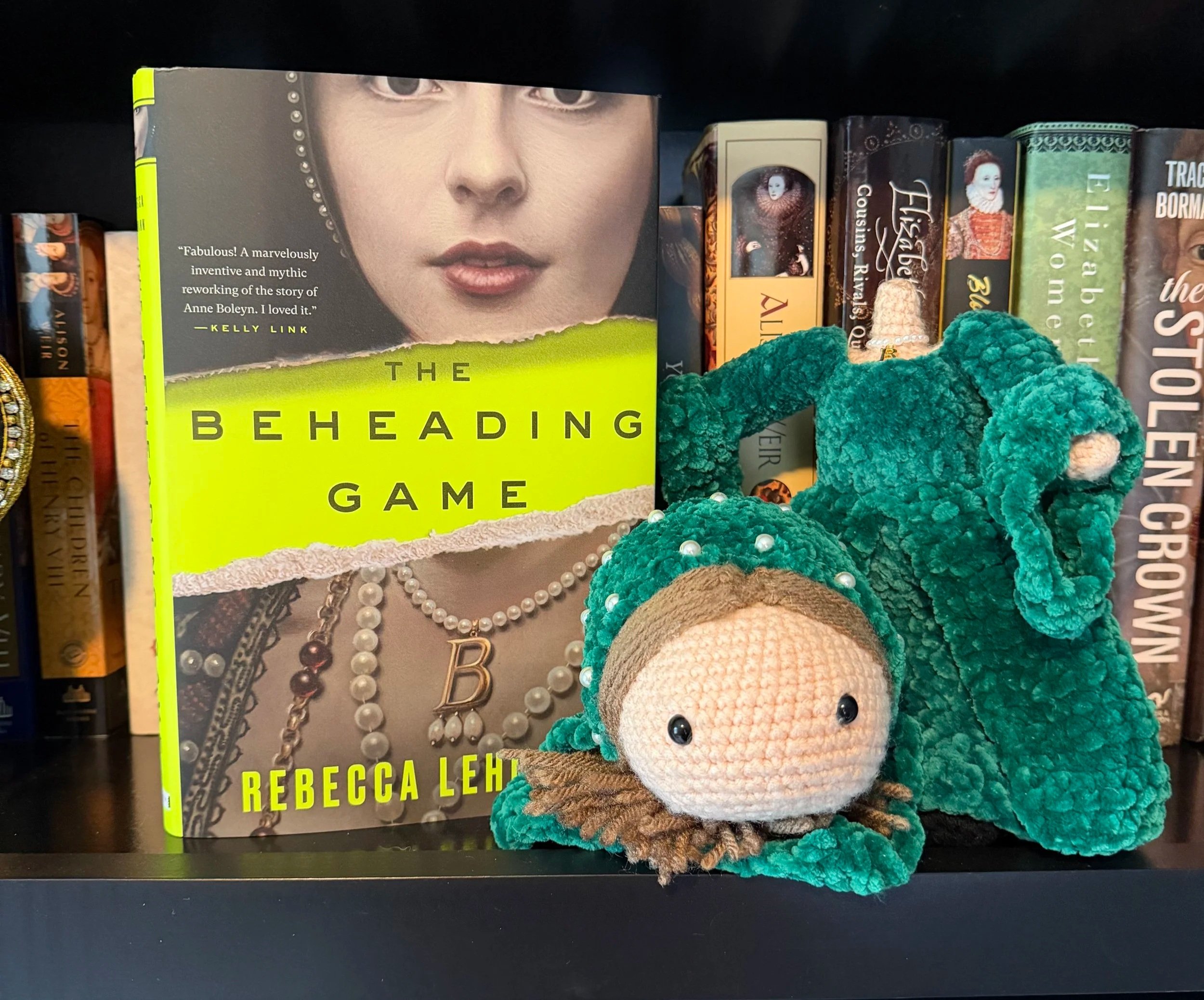
Anne Boleyn wakes up to find herself shoved carelessly into an arrow chest in St Peter ad Vincula.
Her first quest: sew her head back on.
Her second quest: kill Henry VIII.
Anne Boleyn and ghosts, I’m there. Anne Boleyn as a ghost? Yes. The ghost of Anne Boleyn set out to seek revenge on Henry before he can marry Jane Seymour and disinherit Elizabeth? My god, the perfect premise does exist!
Even if I weren’t an avid Anne Boleyn lover, this cover alone would’ve captivated me enough to pull it from any bookstore shelf. In my mind, Anne favors Leighton Meester, and it’s her eyes I saw peering back at me, neck hidden by a ripped-out collar. You don’t see a lot of Tudor historical fiction on the mainstream shelves, and I was especially interested to note that the blurbs weren’t from our usual Anne Boleyn suspects: Tracy Borman, Alison Weir, Owen Emmerson, Natalie Grueninger. Instead, lines of praise from Kelly Link and V. V. Ganeshananthan—a literary and Tudor world overlap. Intriguing.
The novel begins with an epitaph from Sir Gawain and the Green Knight, one of my favorite tales, invoking the novel’s title, The Beheading Game. In the Green Knight, a mysterious visitor appears at a court dinner party to offer an intriguing and impossible bargain: behead him, and he’ll kneel down and allow the blow, with the promise in one year’s time, he can return to deliver the same stroke. It’s a brilliant pairing here, the idea of Anne resurrecting in a similar fashion on a quest to deliver to Henry the same blow she was dealt.
As Anne pieces herself back together—metaphorically and quite literally—she wanders the Thames riverbank, scouring for food, forced to live in shadow as a commoner and understand what every day is like for many of her subjects. The way in which Lehmann paints the character of Anne is gorgeous: she is fierce, she is unrelenting, she is stubborn. But she also acknowledges when her fire has burned too bright and too hot, knows she sometimes needs to reign herself in, and begins to understands that she has led a privileged life that she’s taken for granted as being entitled to. I love her calculation, her wit, and her drive, and yet how it’s also coupled with softness, tenderness, and vulnerability at times. Often, Anne is depicted in one extreme or the other: the fiery shrew, the alluring whore, the pious victim. Anne is and has always been far more complicated than that, and Lehmann captures all of those faucets expertly.
Along her journey, Anne befriends Alice, an occasional prostitute, who agrees to help her in exchange for a promised sum. When Anne offends Alice in one exchange, scoffing that Alice surely is “not a gentle lady,” Alice promptly demands Anne remove the gown she’s lent her.
“What did you say to me?” Anne asks, stunned someone would speak to her like this.
When Alice repeats the command to remove the dress, the threat she’ll leave Anne there in her undergarments, helpless, Anne’s apologies seem to be not just out of fear of abandonment, but an understanding that before, the toleration of her sharp tongue was a given; she could say whatever she liked. Now, she has to learn to rely on others who can easily refrain from helping her, and she has to develop a friendship based on trust and honesty rather than the false praise and automatic obedience she’s used to. It’s a smart characterization of Anne, and exactly how I believe this might have played out had Anne ever been put in a more humbling position. In my mind, Anne is fully capable of kindness, and she loves from her depths. But she’s also used to getting her way no matter how she behaves, and I loved the unfolding of her character as she had to learn to reign in some of her impulses.
While I was fully drawn in to the action—I finished the book in two days—I did find some of the more reflective passages a bit dragging. Anne retreats into her own head quite often, remembering, thinking, and considering. It’s clear Rebecca Lehmann has read the shit out of every bit of Anne Boleyn biography on the list—before scanning through her list of resources at the book’s end, I could tell which sources she’s consulted and that she’s engaged with the same historians and books I have. Her research is well woven into fiction, and the choices she’s made are smart and fit with the story she’s telling. For example, she decides Mary Boleyn’s children are, in fact, Henry’s; Anne and Henry were in love and Anne was not lured by her male relatives into the king’s bed; Anne truly does believe Henry and Katherine’s marriage is unlawful; she provides great imagined moments of heated motivation to Anne’s accusation against Charles Brandon and comment about wishing to see Spaniards at the bottom of the sea. The imagined scenes of Anne growing up in France or appearing at the Field of the Cloth of Gold are steeped in both historical truth and fascinating imaged scenes. And while I admired the depth of the research and appreciated the context for readers who might be less familiar with Anne’s story, there were times the narrative slowed down dramatically to (as it felt to me) give historical exposition in sections that felt too large and too long. I’d be interested to hear how this reads to someone less familiar with Tudor history—as I’ve noted, the readership for this novel doesn’t seem to be the usual Tudor crowd, and I’m assuming the aim was for it to be more accessible mainstream. It’s entirely possible these sections that felt slower to me (I found myself thinking, yes, I know all this, let’s get back to the present!) would feel entirely relevant and propel suspension in a different way to someone who hasn’t read extensively on the Tudor period. For my part, I wanted more of Alice, more of Alice and Anne especially, more of Anne traversing around England and tiptoeing around court, and less memories of the before. However, it’s worth repeating that these sections, despite making the narrative slow down for me, were very well-written; the blending of fact and fiction and filling in gaps is superb.
Overall, I thoroughly enjoyed this novel and would have stayed with it for many more pages. I was convinced more than once I knew how it was going to end, and more than once I changed my mind. She’s going to get caught and killed again. She’s going to kill him. She’s going to forgive him, as the Green Knight did. She’s going to kill him and he’ll be resurrected, too. She’s going to give up and take up a life in the country. Lehmann had me guessing and changing my guess throughout, and by the end, I was thoroughly pleased not only with the outcome, but with the surprise I felt in how she tied it all together. It was marvelous, thoughtful, and lovely—and so Anne Boleyn.